top of page

Final Project
The following illustrations were created as part of my final project for my Medical Art MSc
Overview
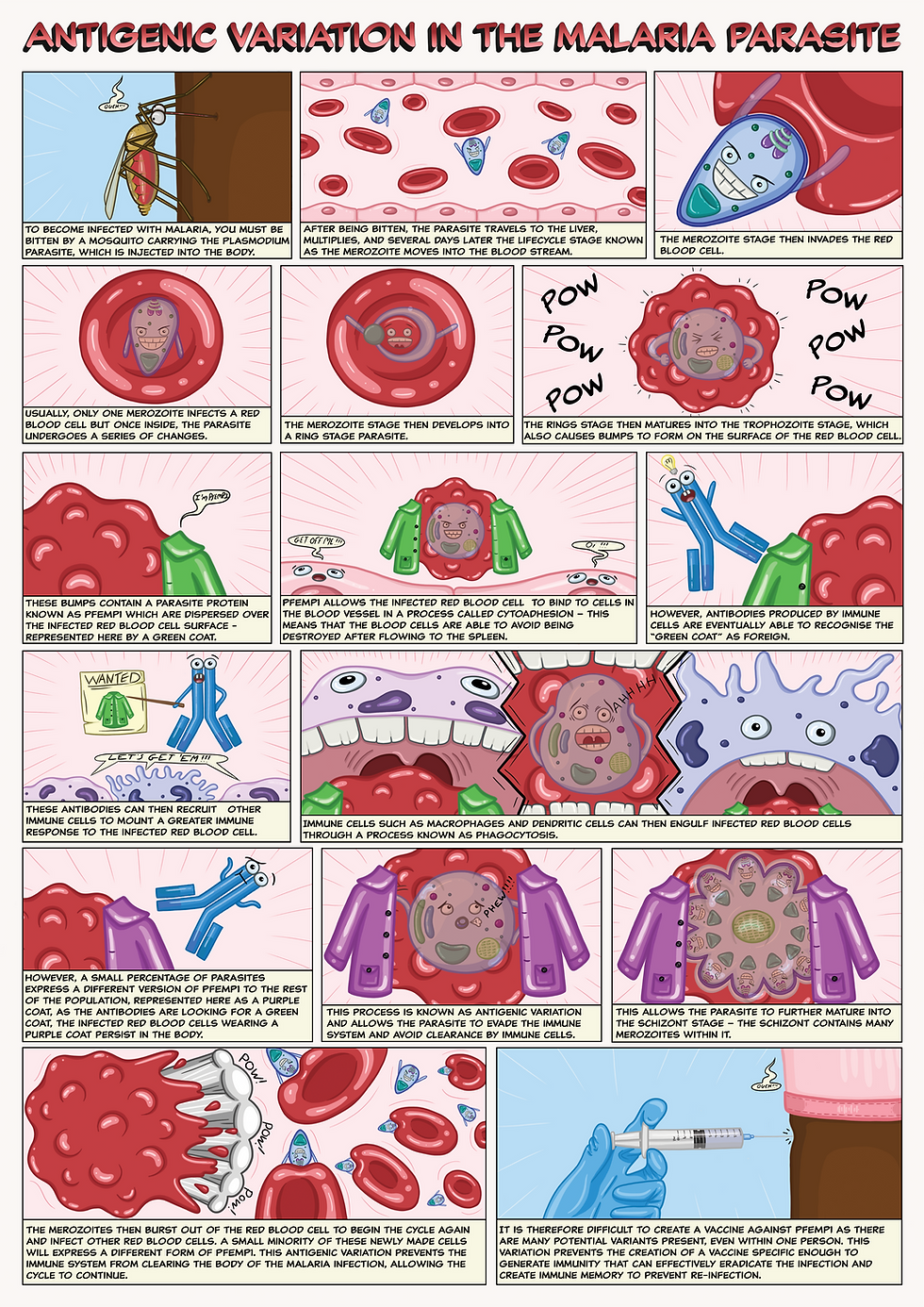
This project aimed to assess whether different styles of illustration and the use of an analogy impacted the learning and engagement of different demographics when explaining the process of antigenic variation in the malaria parasite. In this case, the analogy used was different coloured coats to illustrate this process. Four illustrations were created – a plain comic illustration, an analogy comic illustration, a plain realistic/scientific illustration and an analogy realistic/scientific illustration.
Different demographics were surveyed on their opinions of the illustrations, including members of the public, School of Life Sciences staff involved in parasite research at the University of Dundee, and School of Life Sciences students who studied the fourth-year parasitology module at the University of Dundee.
The comic style illustration began as a pencil sketch which formed the basis of the rest of the illustration - completed in Adobe Photoshop. Many layers of highlights and shadows were built up to create the characteristic comic-book aesthetic. The accompanying text remained the same across the illustrations to make sure the illustrations themselves were impacting learning and engagement. This information was designed to be accessible to a range of audiences.
Comic Illustrations

The realistic/scientific illustrations were first modelled and painted in ZBrush. Following this, texture and lighting were added in KeyShot. Each component was individually rendered and the images were taken into Adobe Photoshop to be layered in order to create the appearance of the parasite being inside the red blood cells. The backgrounds were kept simple to focus the viewers attention to the process of antigenic variation depicted below.
Realistic/Scientific Illustrations


These results could suggest a link between audiences with the least knowledge of antigenic variation, such as members of the public and students, preferring illustrations with an analogy – possibly due to the added clarity an analogy may provide. There may also be a link between those with a science background – such as staff and students – valuing accuracy of information rather than engagement as both of these groups chose either the plain or analogy realistic/scientific illustration as their favourite overall, as opposed the comic which provided a depiction of antigenic variation less true to life.

Results


bottom of page